Margaret “Maggie” Pollock (1861-1931) was a Canadian clairvoyant medium active in the Spiritualism movement centred around Buffalo at the turn of the century.
From Western New York to her home in the rural Western Ontario village of Blyth, Maggie was renowned for her abilities. People would come to the Pollock farmstead from all around for the chance to sit with her. She never demanded payment, though folks tended to leave a tip. And she never made promises. She simply shared what spirits showed her.
While living in Buffalo in 1897, Maggie returned home for a visit. Her services were so in demand, she had to turn people away. The Brussels Post reported that the “clairvoyant, clairaudient and psychological test medium” was only in town to see her sick sister and the writer expressed hope that “she may return shortly and remain for a time at least giving us an opportunity of consulting her as a medium.”
When that same paper reported on Maggie two decades years later, the story was quite different. She was still a well-respected community figure known for helping people, but 58-year-old Maggie’s clairvoyance became a crime.

One November day in 1918, farmer John Leonhardt discovered the stash of grain missing from the stable, two miles from the house. On December 6, his 26-year-old son hitched up and drove 21 miles from Brodhagen to Blyth. John Jr. stopped to pick up his brother-in-law, George Bennewies, along the way and they reached the Pollock farm around 3 p.m.
Maggie had been unwell and wasn’t sure if she could help, but she was willing to try. They sat together in her kitchen, Maggie holding one of John’s belongings with her eyes closed. After five to 10 minutes of still silence, she described a vision of a stout man with who lived in a dark house near the stables. He’d come on a buggy drawn by a long-necked bay horse and carried new bags. After stealing the oats with the help of a boy, he headed west.
Though she’d never been to the Leonhardt farm, Maggie could detail the stable’s unique design. And John had seen those westbound tracks in the mud himself. Satisfied with the information, he gave Maggie 50 cents for her time.
The Leonhardt’s likely took this information to the police in the hopes of finding the culprit. It’s unclear if they ever found justice for the theft, but the police found a different suspect.
On April 21, 1919, the police magistrate charged Maggie as follows:
“In the month of December 1918, she did unlawfully pretend, from her knowledge in an occult and crafty science, to discover when and in what manner certain grain and oats supposed to have been stolen from one John Lienhardt could be found.”
The case was tried on June 30 at the Huron County courthouse before Judge Henry Dickson. Prosecution argued that the law makes it a crime to “pretend” and called these practices “dangerous to the public welfare.” Maggie’s lawyer, Charles Garrow, argued that it was no crime to tell the truth.
On the stand, Maggie paraphrased 1 Corinthians 12:8: "To one there is given through the Spirit a message of wisdom, to another a message of knowledge by means of the same Spirit”
Like most of her community, she was a practicing Christian. Ministers from the local Presbyterian, Anglican, and Methodist churches testified in her defence. One even admitted taking friends to see her for a reading. For her, spirituality and spiritualism are intertwined.
When asked if she has powers, Maggie responded:
“No, no, but as this intelligence comes to me, I feel as if I must speak it out. It is perfectly natural. There is nothing of cult, nothing pretended, nothing of any kind of deceit, no kind of sorcery or witchcraft. None of that is connected with it. It is simply a God-given gift.
It is beyond what we can get in this life, this intelligence. They have passed on from here. Their eyes are open, their spiritual eyes have become clear. From the spirit side of life, these parties return with this intelligence. I see it as they give it.”
Maggie described herself a clairvoyant, clairaudient, and psychometrist. She talked about her innate ability to communicate with spirits. How she spoke to her mother’s spirit the day of her funeral. How she told her father’s ghost he passed on. How she knew where Mrs. Sinclair would find her lost ring.
Mrs. Grace Sinclair, wife to a Brussels lawyer, was a witness for the defence. She’d gone to Maggie when the precious heirloom from her mother went missing. Mrs. Sinclair’s late mother appeared to Maggie and told her where to look. It was on their property and would be found when the snow melted. The Sinclair’s tried to melt the snow, but the ring wasn’t there. Maggie insisted on patience. Come spring, the ring was right where she said it would be.
Maggie also experienced psychic visions. Before she knew about planes and cars, she saw them in her mind.
“Do you know what I saw when I saw an airship in my vision, what I thought it was? Well, I thought it was a heavenly chariot full of angels. Then I noticed as it descended that it had wheels and that it came right down beside me. And the angels proved to be beings like myself, and then I could not understand it at all. Then, when I was driving, I had a vision of a motor car behind us, and that it ran without a track and stopped every now and then. And I thought that was very strange too.”
While reporters are careful not to make any claims about Maggie’s abilities, one writer does editorialize on her unflinching convictions.
“When she impresses the observer most, it is her absolute belief in herself. She is convincingly honest and straightforward, and this is the reputation borne by the whole family and her father.”
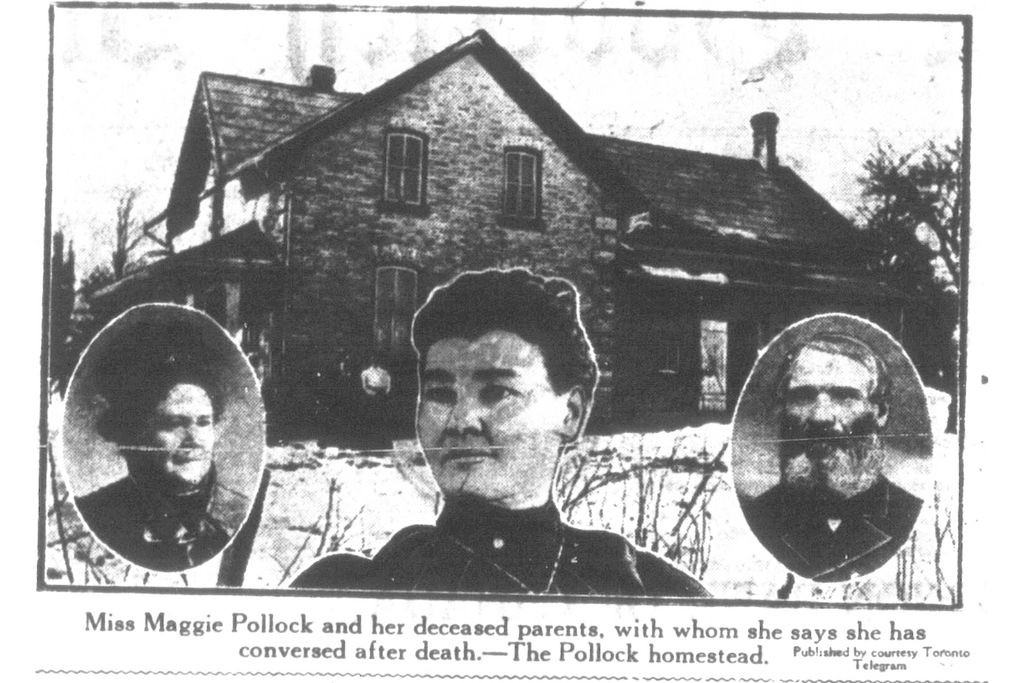
Maggie’s parents, James and Jane, were Irish immigrants who met in Ontario in the mid 1800s. They carved out their family farm on a plot of land that would soon become the village of Blyth, 85 km north of London. Based on ancestry.com and census reports, Maggie had one brother and three sisters.
As a girl, communicating with spirits was second nature to Maggie. They looked so real to her, she couldn’t always tell them apart from the living.
“I would see people distinctly that had gone. Yet I didn't know. Others again, I knew. These things were not at all unnatural. They were perfectly natural. There was nothing unnatural, nothing superhuman, nothing beyond human. There was no pretence, nothing but simply as it is given to me.
When about the age of 10, I used to see people in my room and around my bed and hear them, and tell my mother in the morning that I had such a dream, only I wasn't asleep. And my eyes were wide open. This I did repeatedly, but they never paid much attention except to say, ‘Oh, you're always dreaming.’ I was never fond of school, but answers used to come to me. At night, I used to hear lectures given by people when I was supposed to be asleep, and I told my mother, ‘If I could only talk as well in the day school as I could at night, I'd be all right.’ Of course, it wasn't me at all,” she added, “but other people that I heard.”
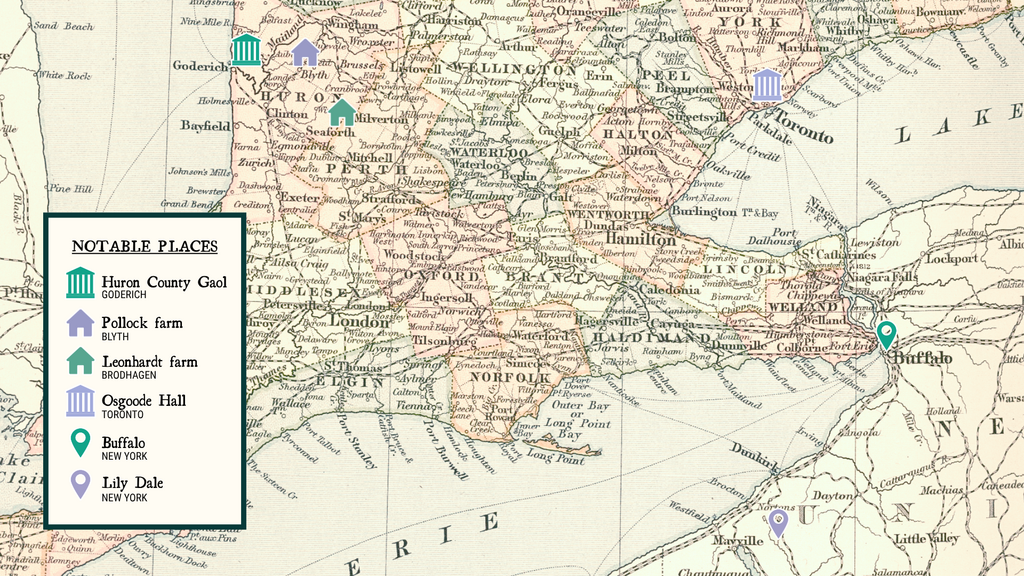
Maggie never married and spent most of her life living on the family farm, but her training in dressmaking led to some travel. Not long after train service comes to Blyth in 1877, she followed a psychic vision to Buffalo. It wasn’t until she got there and recognized her friend’s house and elderly mother, that Maggie realized it was a vision.
“Up until that time, I had never thought I was different from anyone else by the way of seeing and hearing things. But as my work took me to different places and homes, I sometimes said things that seemed to startle customers.
‘What makes you say that? How do you know that?’ they asked. And then I'd wish I'd held my tongue and been more guarded…Then I got curious about myself and I realized I had a God-given gift.”
It was likely no coincidence that Maggie felt drawn to New York State’s “Burned-over District”. Throughout the 19th century, western and central New York became a hotbed of social reform and religious movements. Women’s Rights. Abolitionism. Utopian Communes. Revivalism. It’s the birthplace of Mormonism and Seventh-day Adventists. It’s also the birthplace of Spiritualism, a social and religious movement centred on the belief in an afterlife and the potential to contact this spirit world.
Maggie spent time among fellow Spiritualists in East Aurora and Lily Dale. On one occasion, the Society of Physical Research honoured her with a leather-bound book.
But Maggie didn't share her gifts to get attention or make money. It’s a purpose.
“I would not give what little I know through the divine philosophy. It is my sincere religion. I am ready to defend what is truth, as far as I know. The truth is sacred to me. It is of divine origin. I have never learned it—it has been given through my own organ.
The many who have consulted me have given their evidence, their entire satisfaction of the benefit they have received. I know that our departed friends still live and can communicate with us. Through my organism, messages have been transmitted for which I have received many blessings.
It comforts the sorrowing, heals the broken-hearted. I pretend nothing. I claim nothing of myself. I love God with all the power of my being. I love through His divine power. I aid my fellow beings. I do nothing, nor can I do anything, of myself. God has given us no power, which is no circumstance to be used.
The fact that we possess it is in itself proof that it is our bounden duty to study and develop it.”
Judge Dickson disagreed.
Despite testimony from church leaders, Mrs. Sinclair, John Leinhardt Jr., and Maggie herself, the judge believed, “She might do a very great harm and cause a great deal of trouble in the community.”
He went on to state:
“It surely never could be possible, nor could the defendant expect me to believe, or any person with common sense, that she could, by this communication with the familiar spirits or spirits of departed friends, tell where lost goods can be found. If that is true, then it would certainly turn things topsy-turvy in this world. It would revolutionize things, and it would make some of us sit up and wonder what would happen next. It might be a good thing in some communities to have a person of this kind. It might be the authorities might well consider the possibility of employing a person like Miss Pollock and keep her in continual employment…
…I do not think the Bible ever authorized any person to make use of the gifts of the Creator in the way she professes to—for a charge of 50 cents—professing to locate articles which have been stolen. I call it pure fantasism and religious craze if there is any religion to be at all about it.”
On June 30, 1919, Judge Dickson convicted Maggie under section 443 of the Canadian Criminal Code:
Every one is guilty of an indictable offence and liable to one year's imprisonment who pretends to exercise or use any kind of witchcraft, sorcery, enchantment or conjuration, or undertakes to tell fortunes, or pretends from his skill or knowledge in any occult or crafty science, to discover where or in what manner any goods or chattels supposed to have been stolen or lost may be found.
But the case wasn't closed yet. Judge Dickson forwarded his conviction to the appellate court at Osgoode Hall in Toronto for further judgment with the questions:
1. Was there sufficient in the evidence as a matter of law to justify the conviction, in the absence of any evidence on the part of the Crown showing that the statements made or information given by the accused was false?
2. The accused being possessed, as I have found, of an honest though deluded belief in her alleged power of communication with spirits, was I right as a matter of law in convicting her of the offence charged?
He included this note:
"The accused gave evidence on her own behalf, and I found, as a fair opinion upon her evidence, that she has, and had, the faculty to communicate with the spirits at that time. I believe that the information obtained was validated through the exercise of her claimed powers..."
The day after Maggie's 59th birthday, the Ontario's Appellate Division gathered to decide her case. Charles Garrow appeared on her behalf before Chief Justice Meredith and Justices Magee, Ferguson, Orde and Bayly.
It took them two months to make their judgement and the conviction was upheld.
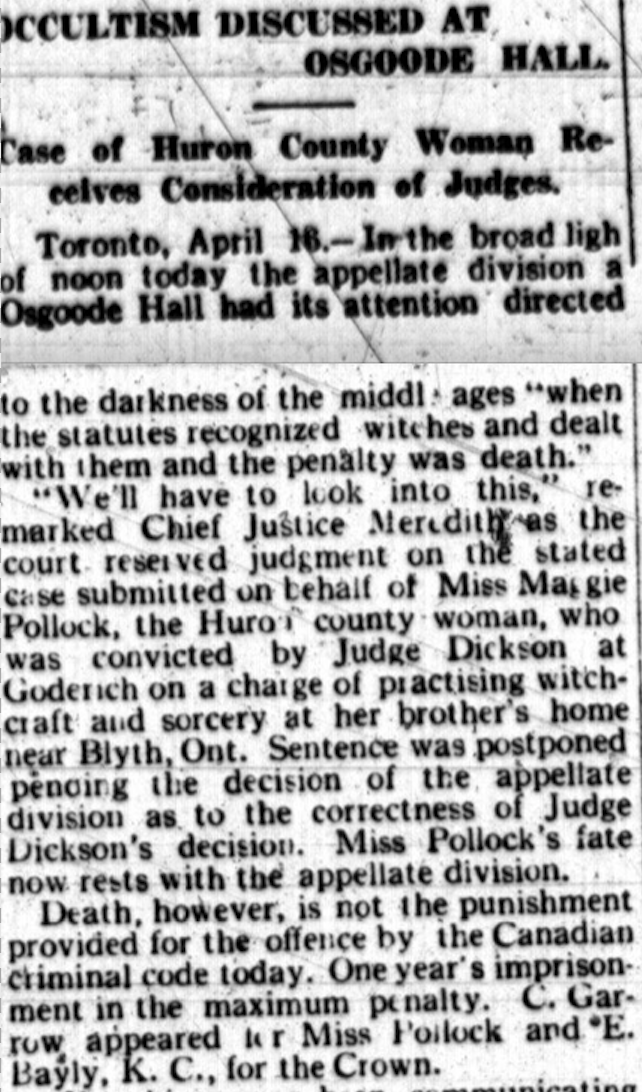
"Has this woman been communicating with the devil—or someone else?" queried Sir William.
Mr. Garrow explained that under section 44 of the Criminal Code it had been charged that Miss Pollock, "by skill or knowledge in any occult or crafty science, pretends to tell where any goods lost or stolen may be found."
Mr. Garrow told of the interview between Miss Pollock and the seeker of vanished oats.
"How much did all this cost?" asked Sir William.
"Fifty cents," returned Mr. Garrow. "And they were perfectly satisfied. They felt that they got their money's worth."
Mr. Garrow asked whether it would be an offence if the things stolen had been located through occult science. He urged that there was no pretence; the woman was absolutely sincere.
"What difference can that make?" asked Sir William. "'Pretend' here means putting herself forward as being able to do this. It doesn’t mean pretending, knowing that she can’t do it."
Chief Justice Meredith: "We ought not to strain the law to protect these people who take money or nothing."
Justice Magee doubted whether the mere shutting of the eyes in contemplative mood, while imparting information from the spirits, indicated practice of any occult science.
Justice Ferguson: "I don’t think she pretended to any science at all, but inspiration."
Justice Orde asked where the line was to be drawn between this and fortune-telling.
Mr. Bayly: "I don’t know what ‘occult or crafty science’ means, but I know the intention of the statute, which is to prevent this sort of thing."
The media kept a close eye on Maggie’s case and continued criticism of the Ontario justice system.
The Huron County "witchcraft" case is rather a ludicrous instance of the oppressive use of authority. Its victim, Miss Maggie Pollock, who lives amid the rich countryside of the Huron tract, may be pardoned if she does not see the joke...It is pretty late in the day for the Attorney-General's department to begin pursuing old women who think themselves "witches" and are so regarded by their neighbors.
The article implied that the Leonhardt’s did recover their oats based on Maggie’s insight:
At any rate, the owner of the oats got good value for his money, for when, on learning of the theft, he at once drove over to see Miss Pollock and paid her fifty cents for going into the trance that produced a very accurate message.
It is quite likely that if he had driven to Goderich to consult the Crown Attorney, the High Constable, and the other legal officials, he would still be minus his oats.
The writer went further to defend Maggie:
Miss Pollock seems to be a much more advanced type than the old women of the seventeenth century who were put to death on the order of Sir Matthew Hale and other noted jurists. They were crude and moderate in method. She is said to be an authority on the works of Sir Oliver Lodge. If the latter's claim that he has proofs of telepathy, and that it is as ordinary a phenomenon in Asia as the telephone with us, is true, why should not an old woman in Huron County, Ontario, be endowed with occult powers as well as any bewhiskered old yogi in India?
Anyone familiar with the rural sections of Ontario knows that old women supposedly possessed of telepathic powers are as prevalent as illicit stills. Their neighbors have a deep belief in their powers based on results in the location of lost and stolen articles that are quite amazing and inexplicable. Nor do they resort to so cumbrous a method of evoking occult information as the tedious process of the ouija board.
Oct 21, 1920 | The Brussels Post P.1 "Miss Maggie Pollock Case"
In October, Maggie went back before Judge Dickson for sentencing. Her sentence is suspended, meaning she was free to go on the surety of herself and her brother. She was also free to give her opinion to whoever asked on the condition she stop practicing the occult, or pretending to communicate with spirits. People could still ask where to find their missing items and she could still answer, as long as she didn’t claim to know by psychic means.
“If proper authorities were to summon Miss Pollock to demonstrate her professed powers at a given time and place, in connection with cases prepared for the purpose, one of two results would follow: she would succeed or she would fail. If she failed, she would be discredited and effectually disposed of. If she succeeded, everybody who has lost anything could be told where to find it, and she could tell the world over. Why, in the name of all that is sensible, should she not be allowed to do it, plenty of it, all she can, and be paid by the Ontario Government, perhaps times the salary of a sheriff for doing it? There is a way to cope with this sort of thing more intelligently than by merely putting the ban of the law upon it.”